
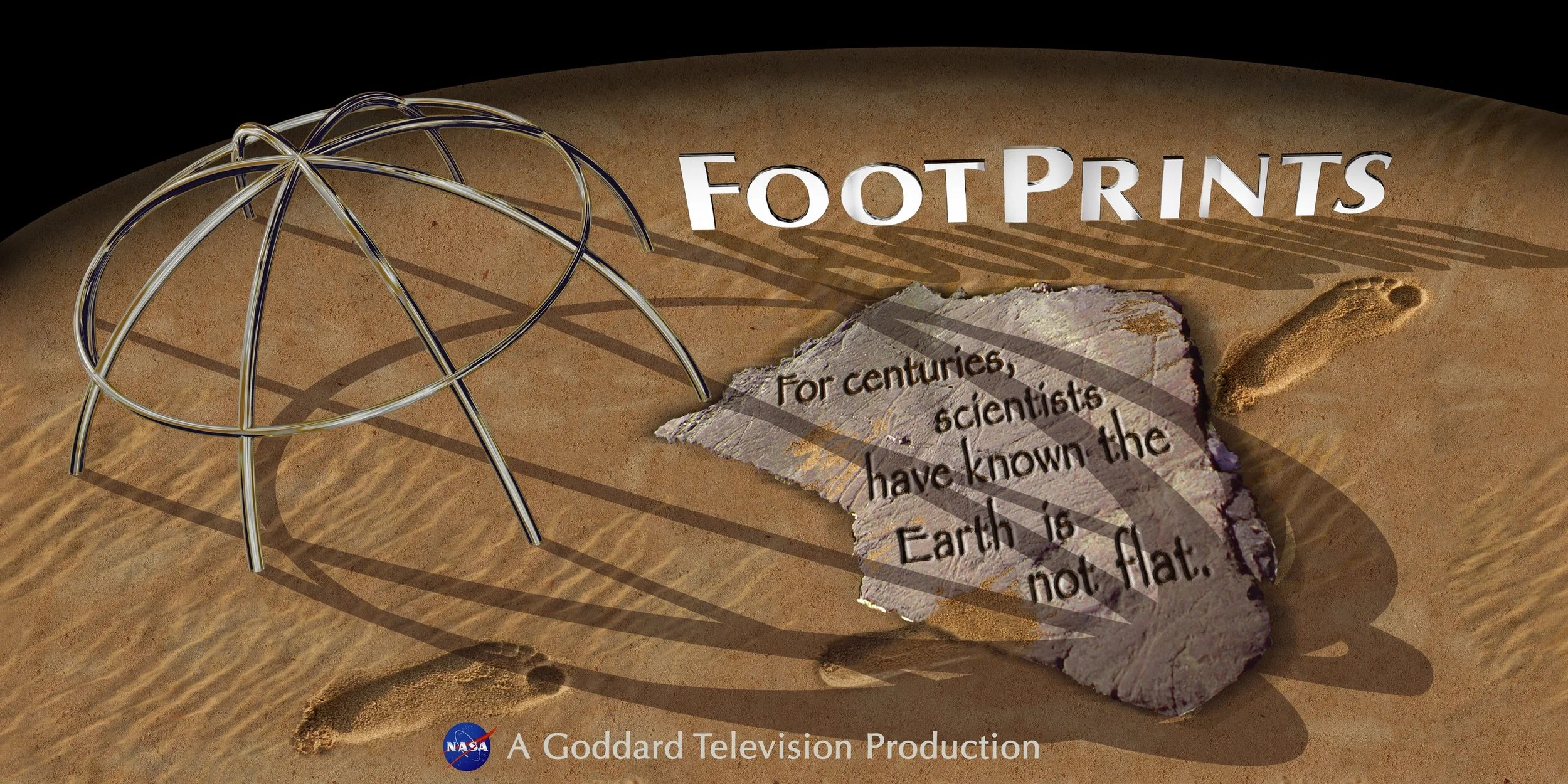
This is the original movie poster for FOOTPRINTS. On opening day, there were only seven spherical theaters in the world.
This is the second in a two part series. Check out the first installment here! (Hey! You really ought to start at the beginning, right?)
It’s early January and Vicky Weeks is spritzing her glasses. Then, as she always does, she takes a cleaning cloth and carefully polishes the lenses, a ritual I’ll watch her do at least a thousand times in the years we’ll ultimately work together. The physicality of the act is the perfect metaphor for a master editor: Vicky sees things clearly.
But in early January of 2006, I don’t know this about her yet. I don’t know about her surgical attention to detail, or her intense passion for life outdoors, or her excellent judgement in terms of pacing and narrative flow and visual rhythm. We’d only recently met, with just limited awareness of each other prior to what started as only an expedient partnership. Funding for her billet in NASA Goddard’s Special Projects in Education (SPIE) Office was running down, and management had essentially told me that if I wanted to work with an editor, it would be Vicky or nobody.
At the time, I knew she had only a few years of experience. At NASA it’s not uncommon for an editor also to spend time in the field as a videographer or a producer. Same goes the other way too, with producers often cutting their own material. When I asked her former SPIE supervisor for his thoughts about my new partner, he described her as a tenacious problem solver despite limited career experience, a smart and clever artist, someone willing to dive into unglamorous problems.
I would soon discover that those were only her most obvious assets. With Vicky, I could not have been more fortunate in finding a creative collaborator, and she will always be a trusted friend.
Our staff supervisor, Pat Kennedy, allowed us to wedge ourselves into a rarely used small office, largely cluttered with boxes and cables and other electronic detritus. Even as we tried to find creative traction on a project that still had no discernible direction, we first needed a place to plant ourselves. We bent to the task of making the space more livable, more useful. Boxes of junk went out, cleaning rags came in, and with the help of some determined elbow grease and second-hand furniture, we made a workable production studio. History will record that Vicky and I basically camped in that small room for the next seven years as we worked on a long list of exciting projects together. (But that’s a note for future tales.)
The most important thing we did in those first few weeks was talk. We also made drawings and sketches. We paged through books about art and science. We talked about movies and photography. We talked and talked and talked. We did not have a spherical screen for reference, and we did not yet deeply understand how to even think about developing content for it. What we were doing, however, was building a shared vocabulary about how to approach the project.
The other big thing I did that winter was start hammering together a draft script. I decided to write it as if I knew how to produce it for The Sphere, fully aware that I did NOT yet know how to produce it for The Sphere. My feeling was that with such limited direction from our NASA customer, I had a de facto license to think expansively. My plan was to use the script as a living document, something I could manipulate and refine as we started developing visuals. It became an artistic scaffold, pushing us to solve problems in order to achieve certain messaging goals, and responding to opportunistic discoveries as I adjusted it to fit resources at hand.
NASA Goddard houses two of the US government’s most accomplished animation studios, the Conceptual Image Lab and the Scientific Visualization Studio. In 2006 CIL, as it’s sometimes called, didn’t yet have its official name, but the core group who founded it had already earned a well-deserved reputation that extended far beyond the Goddard fence. One afternoon in January, a senior artist there named Susan offered a keen observation that deeply resonated. A quiet, intensely creative artist with excellent judgement, Susan commanded respect when she offered an opinion, something she rarely ventured unsolicited. Standing in the atrium of our plain government building, she told me that The Sphere should not automatically be obliged to communicate science just because it came from a science agency. “It’s just a screen,” she said, stating what should have been obvious. “That means you can put anything you like on it, but whatever you put on it will probably make the most sense if the image fits naturally on a sphere.”
Sometimes the thing you already know gains mass when it’s emphasized by someone else. I had already started to believe this, implicit in my own conceptual lightbulb moment over winter break. But extending this idea so that it became a design principal meant figuring out a solution to a common challenge with spherical media: if I’m seeing something on my side of The Sphere and you’re standing on the opposite side, you’re probably not seeing the same thing at the same time.
One common solution immediately comes to mind. A producer could replicate an image and place it three or four times around The Sphere at roughly the same line of latitude. Everyone in a theater would be able to see the same thing at the same time.
Echoing Susan’s note, I argued for something different. Was there a way to show a full screen “wrap” so that everyone would see an aspect of the whole—the side of The Sphere facing them-- even if they weren’t seeing precisely the same pixels at the same time as other people around the room? Could we deliver singular, spherical images without replicating elements around the sphere? In other words, was it possible for some part of an image to work equally well for everyone in the theater, even if everyone wasn’t seeing the same thing at the same time?
That immediately presents a challenge. If, for example, you’re looking at a data visualization of an Atlantic hurricane, and you don’t want to show that hurricane in multiple rectangular frames all the way around the sphere, you have a problem. A big slice of the audiences will see the Pacific Ocean while your storm crashes into the Carolinas. What to do?
The plan we settled on for this scenario is one I still use to this day. We needed to design the scene so that the hurricane passes in front of all viewers around the screen over a period of time while still fitting within the narrative timing of the movie. The screen needed to rotate on cue, in other words. Timing can make or break a movie—one of many reasons editors matter so much--and to worry that someone in the theater might miss seeing something at a critical moment sounds like a recipe for peril.
But the rewards for making this work were potentially immense. If a hurricane appeared in only one place on The Sphere, but the screen rotated so that everyone could experience the storm appropriately, it would “fit” onto the screen in a much more satisfying way than if it were window-boxed and replicated in rectangular panels floating at the equator. Replicated rectangles were just proxies for conventional television screens. “Full wraps”, as we sometimes came to call them, indicated content designed specifically for a sphere.
Images on The Sphere would have to rotate at variable speeds, delivering pictures where they needed to be as precisely as any traditional cinematic depiction of a screen kiss, or car crash, or jump to hyperspace. The movement would need to accommodate the script; the sound design would need appropriate cues to support the visuals; the visuals would have to show up on time and on location as the screen appeared to rotate.
A data visualization of 2005’s devastating Hurricane Katrina became our research testbed. As it appeared in the final film, the sequence was only partially successful (I’ve got to be truthful here), but as a sequence that taught us how to deliver many other shots it was a smashing success.
In fact, we had a million things to figure out. Vicky and I started playing around in our spartan editing suite. We knew this much from the NOAA team: all images destined for The Sphere needed to be in a four-by-two ratio, delivered in 4K resolution. (Years later that high resolution technical requirement would become less strict, but not in the beginning.) That meant our “digital negative”—the precise specifications for each frame of the movie-- would have to conform to an image four thousand pixels wide by two thousand pixels high. If movie geeks reading this are wincing, wondering why we didn’t go with a 4096 x 2048 frame, you’re asking a good question. In those early days, we simply….didn’t. NOAA told us it should be a perfect four-by-two; we delivered a perfect four-by-two. Truth is, those extra pixels would have made the already brutal render times we faced even more painful, but suffice to say, the standard NOAA specifications in those early days were “pure” four thousand by two thousand pixels, cylindrical equidistant projections, delivered at thirty frames per second (not traditional video “drop frame” 29.97).
Don’t worry if you’re not tracking the tech. These waters get deep, and I won’t make you swim through more for the remainder of this story.
In 2006, the process of transferring 4K images around our various offices did not happen easily either. While we had systems for moving data across the NASA network, they were neither fast, nor easy, nor elegant. That’s why our preferred 2006 solution relied on something we dubbed “Sneakernet”. What if we needed data visualizations generated in Goddard’s Scientific Visualization Studio? I’d hoof it across the hall with a portable hard drive, load files from the SVS servers using a FireWire cable that I’d plug into one of their work stations, wait while the data moved, then trot back the other way. Animations from the spunky animation lab just around the corner? Same thing: hard drive in hand, FireWire cable, retrieve, return, plug in to our Macintosh G4 tower and wait for data to trickle in. Had we moved the files across the network, that trickle would have been a glacier.
Like any movie production, our library of assets started to grow almost immediately, even if most of them never made it to the final film. At that time, NASA did not typically make many long form projects, and it certainly didn’t make any in 4K. We rapidly filled the meager hard drives we had and started scrounging for used or borrowable drives wherever we could. Vicky named most of them after birds: heron, chickadee, sparrow, hawk. No cloud, of course: if we couldn’t work with footage physically attached to our editing system, it might as well not have existed.
But technology was—and still is-- always the least of the problem, even if the technical needs were steep. It’s no spoiler to say that we ultimately got the gear we needed (barely) to get the job done. What always matters far more than any technical resources are the people involved in a project.
Here’s where I must light a torch for NASA’s Scientific Visualization Studio. One of the three media tentpoles at NASA Goddard (TV Production and the Conceptual Image Lab shop being the other two), the SVS turned big ideas into exciting images. That Hurricane Katrina sequence I mentioned? It was one of many. From the beginning, I always knew this project would rely primarily on rigorously accurate data visualizations to achieve the goals of the original commission. Led at the time by Dr. Horace Mitchell, this was the team to help us get it done.
Beyond figuring out innovative and visually exciting ways to depict satellite data, the lab’s senior visualizer and day-to-day chief, Greg Shirah, also developed a unique software engine that allowed me to transform how we might choose to paint our screen with various full wrap images. Consider the challenges: all images destined for The Sphere had to be created inside rectangular frames on conventional screens. But to “rotate” these rectangular images, with pixel perfect seamlessness joining the left and right sides of each frame to create contiguous “full wraps”, we needed to process a visual displacement of those rectangles left to right, one vertical line of pixels at a time. There’s more. If we needed to tilt the orientation of the image on The Sphere—not the physical sphere, of course, but the visual depiction of an image projected there—those rectangles needed to be warped in precisely calculated ways even as they were being displaced left to right. Add a mechanism to calculate different rotational speeds, and suddenly a whole range of possibilities opens.
As I’m writing in 2026, these challenges are relatively easy to solve. Not so in 2006! When it was developed, this tool and the various features that accrued to it over time, were effectively first-of-their-kind demonstrations in the SVS. (A couple of years later when Greg updated his code so it could deliver a polished “motion blur” between frames, there were genuine whoops and high fives in the viz lab.)
Benefitting from the endless patience of several of the lab’s core staff, I learned enough command line Unix to pre-process data sequences. To do this I needed to calculate precisely how fast and far we wanted an image to rotate, including how many degrees it might need to tilt on its axis. I’d then upload to the SVS server a sequence of frames that originated from our editing suite, write some code to instruct Greg’s widget what to do with those frames, export the output frames back to my hard drive, and then Sneakernet them back across the hall to our editing room.
This process could take hours, and in the early days it often took many, many iterations. As an entirely new kind of production pipeline we were literally making it up as we worked on it, artistic goals to conceptual methodology to original code development to real-world use case scenarios.
Movie making is always a team sport, and the SVS delivered some of the most extraordinary and most essential team contributions to the whole project. It was our good fortune to continue a partnership with them for years to come. To this day, the SVS remains one of the nation’s top data visualization labs, despite constant risks and pressures from absurdly shrinking budgets in our science institutions.
There wasn’t really a singular moment when we flipped our internal compasses from making a narrated slide show to making a movie. It happened somewhat organically, picking up momentum through the gray days of January and early February. We still didn’t have a sphere for testing, and to the question about when ours might show up at the Visitor Center, I continued to get shrugs from management. “It’s tied up in procurement,” I’d hear, or “Sometime in the next few weeks.”
We all just kept working.
In the meantime, Vicky and I faced a pair of rectangular screens in our production room while we worked on cutting a spherical movie. We started taking test output from our timeline and wrapping it to a simulated sphere inside our editing system, essentially a two-dimensional depiction of a virtual sphere presented on a flat screen. For the filmmakers in the house, this was before we fully embraced After Effects as the editing tool of choice for spherical movies. (In 2006 we used Final Cut Pro 7!) A virtual sphere enabled a crude sense of our compositions, and also enabled us to prototype rotational speeds. Even today, using After Effects and other tools, virtual spheres are an essential part of the editing process for checking compositions and testing movement.
When the first colors of a Maryland spring starting to pierce winter’s gloom, I become aware of a growing tension beyond the already substantial pressures squeezing us. NASA management was starting to chafe at the amount of time we were taking, including precious resources from an increasingly overtaxed SVS. What had initially been scoped as a cool demo project to display some spherical data sets had clearly turned into something else. I couldn’t entirely blame them. They were funding us, even if only by the barest of margins, and they didn’t know what their money was going to get. I tried my best to explain what we were doing, but I was also conscious not to risk over-promising our potential, considering just how much we didn’t know ourselves. For several of our principal stakeholders the tension started to grow uncomfortable. It was hard to trust my assertion that “we’re onto something”, even though nobody had seen anything like the thing we were onto. I think we managed to survive this tension due to the simultaneously palpable excitement had started to build in the shared production spaces, as weird, strangely thrilling visual research experiments continued to spill out of the Viz lab’s render farm. Vicky and I didn’t bar the door to the edit suite either, or at least not exactly, but we also didn’t operate with a wide open, anyone-can-enter policy. Trusted staff knew when to check in, and word started to buzz that something new was taking shape in our small workspace.
The Viz lab wizards were also feeling it, simultaneously pulled into the thrill of inventive discovery just as they were struggling to meet the demands of a production vortex they really hadn’t counted on that year.
We continued; they continued. Management got crankier. Somehow they managed to rationalize that they should at least let us work to the deadline, even if they weren’t pleased about this practical realities of the effort. Their commitment to let us focus on an unclear outcome took some jawboning and careful diplomacy. In early Spring I started to sense that if we crashed unsuccessfully there would be speedy recriminations at the ready. But if—wouldya look at that!--something useful came of this exercise? Success has many parents, and there would be plenty ready to step in and smile for the camera.
The intensity of our work days blurred into a constant foreground reality, a gravitational field that began to absorb all light and matter from the rest of our lives. We’d arrive early and stay late. In the post-sunset shadows of each day’s end we were always sure to send a test render into the queue so we could review our work the next morning. Back then, even just a few minutes of footage would take much of the night to process.
Around this time I managed to scrape a small slice of our meager budget to hire a composer. This was—and remains—something highly unusual at NASA, considering that The Space Agency is not a movie studio. Having helmed a handful of other high profile projects over the years, I had fortunately set some precedents for bringing in outside artists. For this project I returned to a terrific composer named Andre Gribou with whom I’d worked on several other things, and who’s participation had met with previous approval.
I met Andre years earlier when I’d worked in the performing arts, long before joining NASA. I trusted not only his superb artistic instincts and equally reliable work ethic, but also his awareness that as a client, NASA came with a uniquely freighted national identity. This time around, however, considering the growing frustrations and budget pressures facing our project, I only got approval to sign him close to the frenzied end of the production schedule. Even with an early May deadline, Andre and I weren’t authorized to start working before the first week of April. Andre and I had been talking about the whole thing through February and March, of course. I’d quietly primed him with background materials and sketches and script. We’d extensively discussed the non-technical aspects of the film, the way it used real and important data to explore a poetic, even romantic needs for people to ask questions. We talked about how the visuals were not like a traditional film, and how the audience would experience a surreal space that evoked feelings as much as it explained science.
None of this rattled him at all, which is only one of the many pleasures and privileges of working with Andre. If anything, it presented a thrilling opportunity, a chance to sparkle and engage the audience with a vital cinematic component as opposed to just neutral background music. I felt similarly. We needed a score that propelled the narration and could equally carry the movie when we let the images run without words. On the day I called him to say we were good to go, I also said something that we laughed about for years to come.
“Andre”, I said. “I have a word for you. Tango”.
“Footprints” has the coolest score of any government project you’re ever likely to experience.
Vicky and I worked right up until the moment I needed to take our film for composition. We needed to lock the timing of all visuals before started work on music because we would not have enough production time to make adjustments downstream. The movie was not yet finished—not by a long stretch—but we managed at least to get the timing of scenes, cuts, and on-screen events essentially chiseled in stone.
I loaded a digital file of our work-in-progress onto a small hard drive and travelled to the Ohio University where Andre worked as a professor. Once there I’d roll up sleeves with Andre and a handful of faculty friends he cajoled into some session work, and dive in.
Over the next eight or nine days, Vicky and I would talk on the phone several times a day—no FaceTime or Zoom calls back then. I’d send her music files over the internet, easier by far than her sending video files to us. She continued to work on refining the visuals while the score took shape. Simultaneously, I continued to pound on a million, billion other production details, from graphics to sound effects to publicity to the endless and often exasperating internal politics of keeping the overall project on track.
I returned to Goddard with less than two weeks to go before the premiere. The actual, physical Sphere, we were told, was now scheduled for delivery and installation, with a mandate given to the installation crew that it must be ready by the May 4 deadline. That only a handful of these systems existed on Earth at the time meant that only a handful of people even knew how they operated. We certainly didn’t—I didn’t even know how to turn one on-- but at this stage, the absurdities of our adventure disappeared behind a constant physical pressure. We were running out of time, and we could feel it in our bodies.
Vicky and I may have locked the timing before I left for music composition, but as I mentioned that didn’t mean all of the images were ready. For the last few moments of the film we still had a gaping hole to fill, something that we’d simply not been able to solve in time. While in Ohio I was determined to figure out a path forward, something we could execute efficiently and would also fit the movie’s dreamy aesthetic.
I went back to first principles as I thought about the problem, with the central note any images destined for The Sphere should be designed specifically for it. That gave me an idea.
So far, we had leaned on data visualizations and motion graphics to paint our screen. We’d managed to use some live action footage at key moments, and discovered almost immediately that video wrapped to The Sphere carried with it the whiff of magic, a slight-of-hand that delighted as much as it captivated. One of the biggest discoveries we made was that live action depicted in a full wrap had an extraordinary power to illustrate big concepts in abstract ways.
At the time, however, we barely knew how to design such shots, but for this final sequence I wanted to try. I designed a stop-action sequence using sand and stones to evoke the movement of atomic particles and orbiting planets. I drew up some storyboards and made some calls to my colleagues in the conceptual animation shop. We knew precisely how long we needed the sequence to be in our timeline, which meant we could calculate precisely how many frames we would need to shoot. (Remember that one second of playback time equals 30 frames of footage.)
One of the CIL animators, Chris Meaney, was a known engineering problem solver. The guy can build anything, often with an astute visual wit. He had developed a reputation for building props, fixing hardware, and basically adding panache to all manner of productions, besides bringing animated pixels to life. Two days after getting back from Ohio, Chris and I dumped fifty pounds of fine sand on the basement floor of our building and constructed a carefully measured four by two miniature soundstage. We lit it with a small forest of lights, made a plan to deploy approximately twenty dollars of craft store river stones and glass beads, taped storyboards to the wall, and for the next ten hours shot several hundred frames of video, one frame at a time.
First thing in the morning Vicky and I dove into the hard work of turning those frames into spherical media, including multiple Sneakernet round trips through the SVS software.
Like most other weekends throughout the spring, we worked all day Saturday and Sunday, April 29 and 30. There were final audio tweaks, final graphic updates, renders, exports, tests, revisions, and back again. At this stage, a full export of the entire movie took more than seven hours, so we were careful to test only short segments most in need of review. In the meantime, I learned that a third party vendor was literally reading the skimpy installation instructions as they assembled a spherical projection system in the Visitor Center.
At this stage it was also pointless for us to wish we could test footage on The Sphere. With the government literally running out the clock on their own deadline, we had no opportunity to test anything there. The show had to open on May 4th, we were told, but testing? Not going to happen.
With one exception.
There would obviously be a moment when we loaded the movie onto the system for the first time, literally enabling us to see it for the first time. If I had to stay up all night (again), I certainly wouldn’t press play with a live audience watching expectantly unless I had proven it worked. There would be no time to make updates, of course, but at least we would know if it was ready to play or ready to cancel.
On May 3rd, I got a phone call telling me The Sphere was ready. A staff person from our education department named Maurice Henderson had apparently received some rudimentary training from NOAA on basic Sphere operations, and was available to show us the most essential aspects of the system. We jumped in the car, drove across campus, and uploaded the movie onto the main Sphere computer. In 2006, Science On a Sphere required five separate computers running Linux, one for each of four projectors shining on a 90 degree quadrant of the screen and a fifth computer to store the data and essentially act as a traffic cop for moving that data around the system.
Then we turned out the lights and Vicky and I found seats, saying little to each other. Maurice clicked “PLAY”, and a bit of opening text we’d prepared appeared at the screen’s equator, supported by a low, ethereal soundscape I’d constructed. Then, in darkness, the sound of footsteps echoed, followed moments later by Andre’s sublime piano tango, and we were off.
It was probably a good three or four minutes into the film that I realized Vicky and I had our arms around each other.
It worked.
We held hands the entirety of the 16-minute film, anticipating each moment, each scene, each shot. We must have laughed a thousand times, relief and wonder filling us as the world’s first spherical movie shimmered on a round screen just as we had planned it. I will never forget the physicality of that moment, eyes wet as we absorbed the experience. Something like this had never existed before, and we were the first to see it. After months in the battle for its creation, we were literally comrades in arms.
On May 4, 2006 hundreds of science teachers around the country sat in the same theater and watched the movie. We ran it all afternoon, cycling audiences, shocked over and over again by enormous waves of applause and endless enthusiastic questions.
For the next several months all sorts of proud NASA parents beamed. We showed the movie endlessly, often to enormously influential, sometimes even extraordinary audiences.
Steve Wozniak, co-founder of Apple Computer (they used the world ‘computer’ in the early days) personally signed my laptop. The musician Moby asked to watch it a second time, and stayed long after the lights came up, asking all sorts of questions.
At a senior level, closed door government conference, I was asked to show the film to a crowded room of V-VIPs. At the end of the demonstration, none other than an elderly Neil Armstrong walked up to me and shook my hand. “Good job, young man,” he said.
The heads of NOAA, of NASA, of the Department of Energy, and other federal agencies came to visit. Celebrities, musicians, filmmakers: we had a hit.
The New York Times did a feature on “Footprints”. Time Magazine named “Footprints” one of the Best Inventions of the Year.
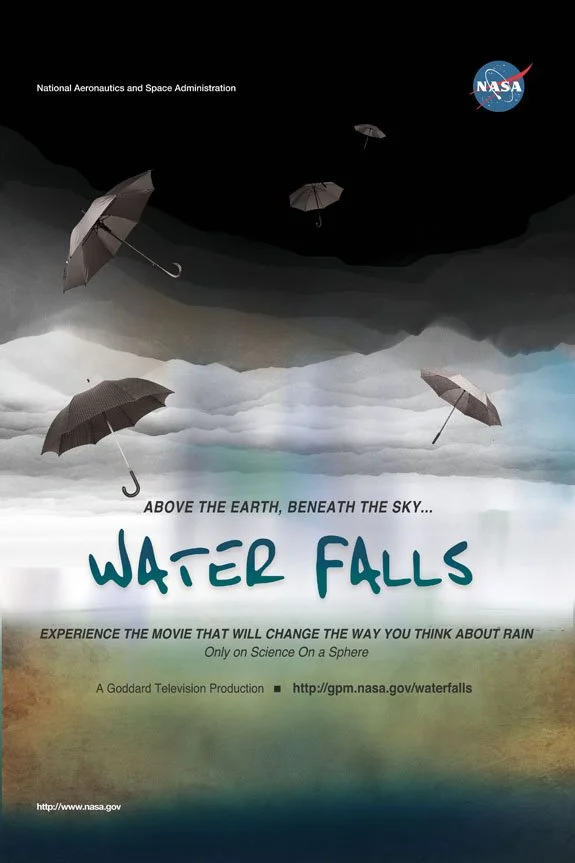
The 2013 movie WATERFALLS was our last spherical film for NASA, describing the Global Precipitation Measurement mission.
Vicky and I would go on to make five more spherical films for NASA and a pair of other spherical films for the Department of Energy, one of which played at an extraordinary travelling sphere exhibit taken to the 2009 COP 15 Climate Summit in Copenhagen. We also produced and directed independent sphere projects, too, even as we continued to collaborate on a wide range of other media projects.
But “Footprints” came first, twenty years ago, right before smart phones stole everyone’s ability to share a experience together.
These days, the idea of a round screen usually evokes the Las Vegas Sphere. The technology they use in Vegas is dramatically different in terms of how images get to the screen, but the geometry is precisely the same: a sphere is a sphere. Our work predates Las Vegas by almost 15 years. It even earned a patent for its unique assertions and capabilities.
Today, NOAA’s Science On a Sphere exists in more than 190 installations around the world, with more coming on line all the time. In these media saturated times, it may not have quite the same sizzle factor as it did in those early years, but the thrill of seeing a seamless, round video appear to hover in a theater still delights and captivates audiences around the world every day. But in its early days, “Footprints” and the other films that followed it helped launch the platform and build the now widely respected Science On a Sphere Users Collaborative Network. We may not have created the physical Sphere, but what we did create built an audience and a capability that still find expressions to this day.
On the twentieth anniversary of this movie, I find myself thinking back to the small team of intensely creative and people who worked on the project. We were all captivated by an initiative to consider something that hadn’t been done before. I find I must state what could easily be taken as cliché: I would not have been able to do this work without the efforts of the extraordinary team. And if it’s not perfectly clear by now, I will always hold a special place of respect for the singularly extraordinary Vicky Weeks.
In an era of media saturation, I’m reflective about a time when the emergence of a singular thing like “Footprints” could cause a ruckus. The legendary NASA scientist Jim Garvin has an expression that I think captures this lament. He says, “Never wait to wonder.” It’s superb advice. We are living in a time where people seem more resigned than ever to put off feeling wonder, or amazement, or even just plain old joy beyond transient consumption and irrelevant dopamine hits.
Not me. I find that as I age, I’m just as enthusiastic to fully immerse myself in creative works, as both artist and audience. With fleeting time—and we all face fleeting time—I find that deep engagements make me feel more grounded than fleeting dismissals. I choose not to consume everything as if it were all ordinary. I cannot just yawn and swipe past 15-second social media posts about flights around The Moon without being moved by the bigger subject: we went to The Moon. I may use my cell phone every day, but the wonder of what that little slab of glass can do never ceases to amaze me. Even more extraordinary, and perhaps more easily overlooked, I continue to be enthralled each summer as the herb garden on my porch blooms and grows verdant, fragrant leaves, energized by nothing more than water and sun.
I do not want to lose that wonder.
In the era of artificial intelligence being able to generate endless content instantaneously, I find that the work I care about most usually comes with human fingerprints around the edges. Work can be digital and high tech if necessary-- “Footprints” is a thoroughly electronic work of art—but the humanity invested in making a project changes its value. Sure, I’ll use artificial intelligence to do things, just like I’ll use extraordinary machines like microwaves to make something totally ordinary, like popcorn. But it’s real, human experience makes me inhale the most meaningful breaths. “Footprints” reminds me just how vital it is to engage with the world. It reminds me that the world is made better only through acts of creation, especially those done with other creative people. Acts of creation define the value of our lives. They generally add structure and context without usurpation of anyone else. When we share context with others rather than simply try to accumulate value for ourselves, we create a narrative that can illuminate dark rooms, real and metaphoric. We can not only feel wonder, but we can share it, too.
—Michael Starobin
Founder, Creative Director
1AU Global Media, LLC
New editions of 1AU Global Media’s blog
FASTER THAN LIGHT
drop the first Monday of every month.