
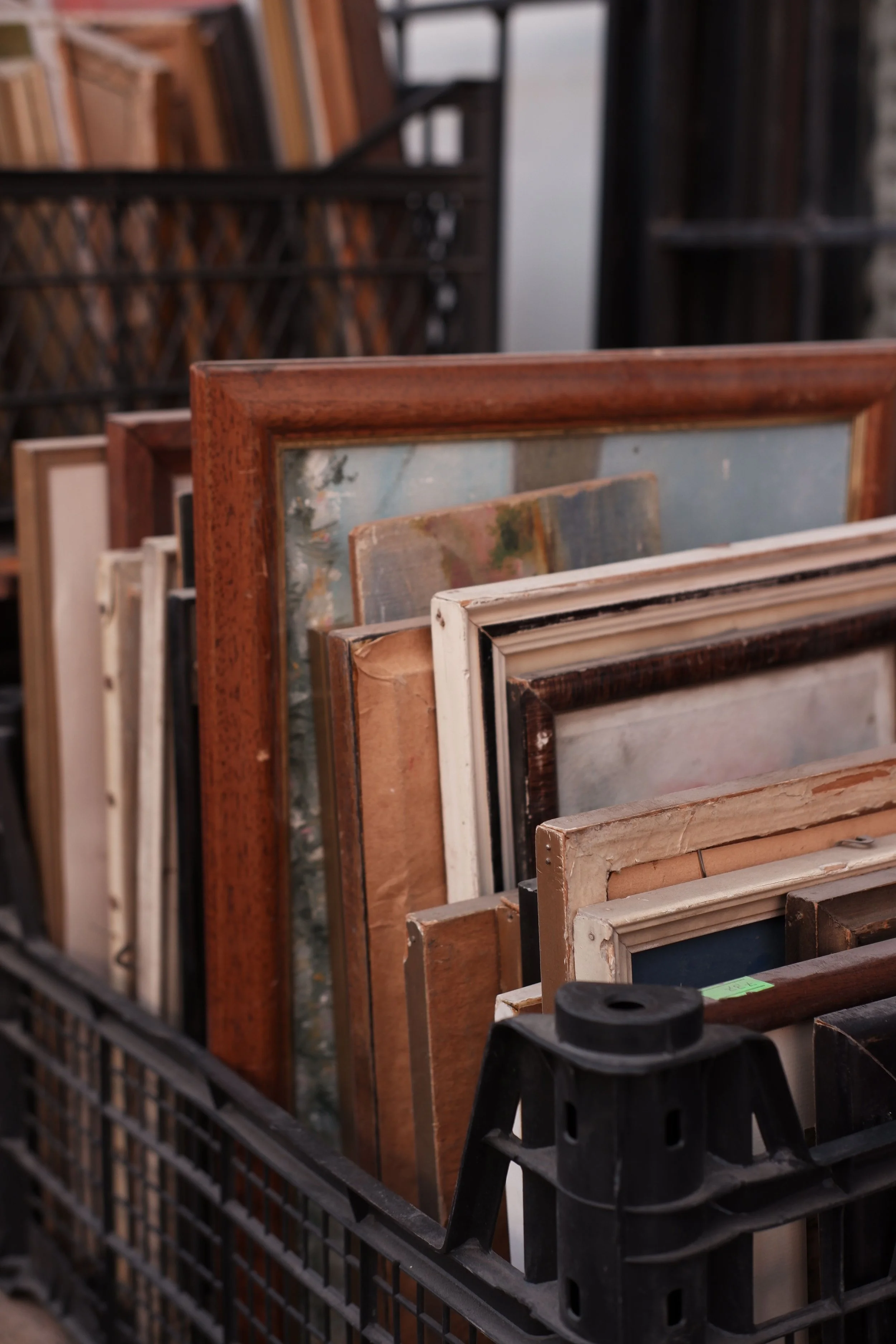
Even if these framed pieces are now relegated to a forgotten bin of castoff works, an artist spent time and energy and focus on making something that did not exist previously. Perhaps the process of “making” is the real value of the work. That’s the genesis of this essay’s title.
A large cache of poems were found in a steamer trunk one day. Nobody had thought to pay them any attention for years. They just sat in the dark in unorganized anonymity. But sometime in the mid-19th century, the collection found its way into the hands of a pair of discerning publishers who cleaned them up, added titles, and bound them into a folio. Emily Dickinson’s poems have not gone out of print since.
Every once in a while, the news fixates on a story about found art. In some European attic that managed to survive two world wars, leaky pipes, blazing summers, and who knows what else, somebody stumbles on a sheet music manuscript or an oil painting on an unframed canvas. A grubby piece of real estate goes to auction somewhere and – – surprise! – – there’s a charcoal sketch found stuck behind a bookcase that hasn’t moved in a century.
This superficially compels a certain slice of the world in much the way that winning the lottery compels attention. It’s the ultimate social media flex to announce that a dust-caked piece of what looks like bric-a-brack discovered in the garden shed might actually be worth six figures to a discerning collector.
What gets lost in this consumer fantasy is that 99.9% of creative work—everything else, essentially— disappears into the ash filled sinkhole of time. An infinitude of valuable artifacts largely do not await anybody’s discovery. Most of it is all gone, forever. Most songs and designs and poems and novels and paintings and so much more simply don’t survive. The odds are against anything surviving. Time and tide grind mountains to sand. Even with the help of human hands stretching across generations, should we really expect a sketch or a sonata to fare better?
And then there’s the matter of value at all: that a patch of paint precisely placed on a parchment should fetch regal sums? Value is only a function of an object’s desirability to others. More desire? More value. If a missing Rembrandt stayed missing, nobody would lose anything. But find one? People will pay for what nobody else has.
I have to laugh as I write these words. Each month as I chatter away in this space to share something I hope will interest you, I’m conscious that I don’t even have the benefit of tangible paper to preserve my thoughts. I’m casting a stream of electrons into a realm that you can only visit by using other electrons as an intermediary. The odds of these words surviving far into the future are exceedingly low.
The master novelist Ian McEwen wrote about this in his most recent book “What We can Know”. In it, he muses about the relative value of creative work that may or may not survive into the future. By implication he’s pondering bigger themes, namely the endurance of things that motivate creative work in the first place, like relationships, and communities, and civilizations themselves.
But perhaps that’s the deeper value proposition for the preservation of art in the first place. It’s not about the persistence of a painting. It’s not about the nostalgic desire for a melody to carry forward forever and ever. The real value of art is in its ephemerality. Yes, I hope you desire what I create, and yes, I hope to continue to make a living creating things. But the value of art as a social function worth doing is the exquisite bright light it shines directly onto the moment of its creation. In its best expression, we can only hope that work gets rescued from its own private steamer trunk so it can cast light on others.
Art, therefore, is really a proxy for love, even if the artist is a crotchety curmudgeon who hates people and lives on a mountaintop. The odds of any work persisting deep into the future are low, and if we’re being honest here, we can guarantee that none of us will individually endure long enough to prove that case. The act of creating asserts an inherent value by giving a reason for even bothering to take the next breath. We make things before they have value.
That’s the same thing with love, isn’t it? Finding it and cultivating it and feeling it doesn’t get you anywhere, and it doesn’t really solve anything. But as an animating force, its ephemerality is fundamental to why it matters so much.