
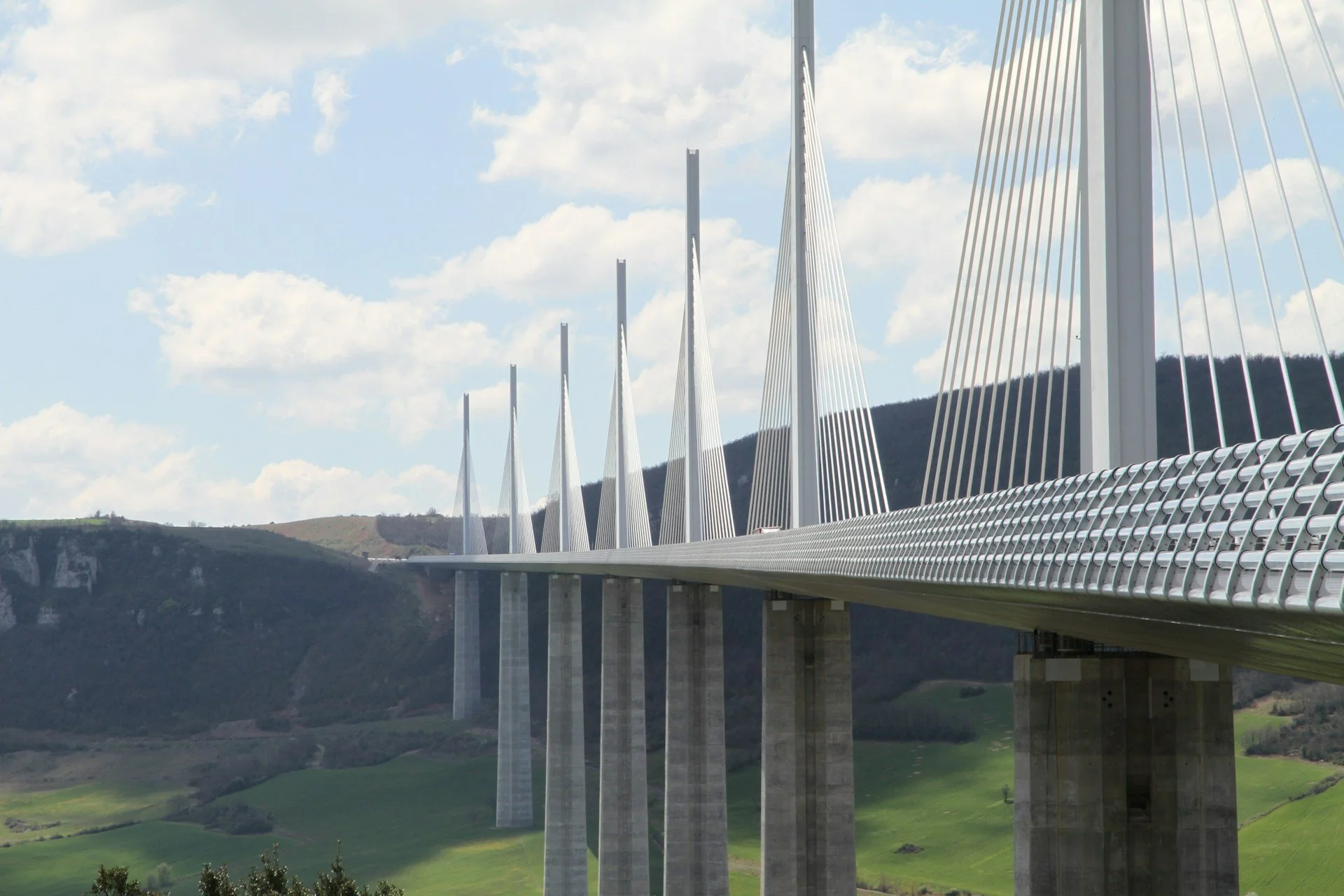
A bridge is easier to cross than it is to build. The people who built the bridge may not have been the same as those who designed it, but that doesn’t make them less important.
Take any creative act that adds up to something larger than itself: a movie, a theatrical production, a bridge across a raging river. These are enterprises that take work and the labor of many hands. They take time. They require complex lists of tasks and tools.
In these blog pages, I have often talked about the differences in how easy it is to consume content – – or cross bridges that traverse raging rivers – – then it is making content or building those bridges. Consumption is entirely different than creation. Lately I’ve been thinking about the component parts that go into larger works. Most of the time when something turns out successfully, it’s because the majority of the piecework— the labor and the parts and the preparations that went into making the thing— were each done with close attention to detail and quality. All of the players played their parts well. Even if an architect does a great job designing a bridge, the bridge will not hold if if the riveting crew comes to work drunk most days. An architect’s plan is only executable if he or she can count on rivets going in straight.
Most jobs that contribute to larger works do not get recorded in the Cosmic Book of Time. We usually don’t know who supplied the strings used by a symphony orchestra’s concertmaster. We do not typically remember who controlled the focus ring on the B-camera on any particular film. A name may appear in the endless credits roll, but most people don’t hang around to study credits closely. (I do, but I’m a geek.) There’s a similar anonymity for the people jamming those rivets into the bridge.
Everyone knows, however, that those rivets matter! All of the little component parts add up. Individually each person may be replaceable as a matter of labor allocation on a spreadsheet, but after a while a creative enterprise becomes The Ship of Theseus . One has to pay some mental attention to the fact that the team who made lunch every day on the film set, or who sewed the costumes in the theater production you just saw, had some influence on the total outcome of the experience.
That’s why I’m confident in the assertion that when it comes to bridges architects matter and riveters matter. One participant may define the creative shape of a project, and thus carry an outsized portion of that project’s purpose. The other, generally less identifiable participant, helps bring the architect’s ideas into tangible being. There may be differing levels of creative ownership here, but each is nothing without the other.
There’s a theoretical aspect to this assertion, of course. To even have this conversation is to accept that we each play part in the larger tapestry of life, and that people of good intention and action matter, even if the results of their efforts may not be equivalent. But this assertion also forces us to look through the telescope in the other direction. Most of us are completely forgettable relative to the grand expanse of time. If life itself – – civilization and all the good and bad manifestations that civilization presents – – are really just large acts of collective creation, then we are all metaphorically just making lunch for the crew. Most of us will be forgotten at the end of the day, and anyone who thinks otherwise really doesn’t get it.
There’s a cosmic resonance to this symmetry. Creative works are essentially built of anonymous acts of personal investment, and the dynamic universe is essentially a grand expression of trillions of smaller events that individually don’t amount to very much. Mozart and Georgia O’keeffe and Margaret Atwood may shine more brightly in comparison to the rest of us, but taken as component parts of global culture over the millennia, even they are just blips on the screen. The anonymous carpenters who helped O’keeffe repair the wooden roof of her studio in New Mexico may be unsung, but without their hammers and nails, she could not have painted the vital works that so many millions of people love so deeply.
We are all, therefore, irrelevant and relevant at the same time. Almost anyone can be replaced, and yet, everybody is irreplaceable.