
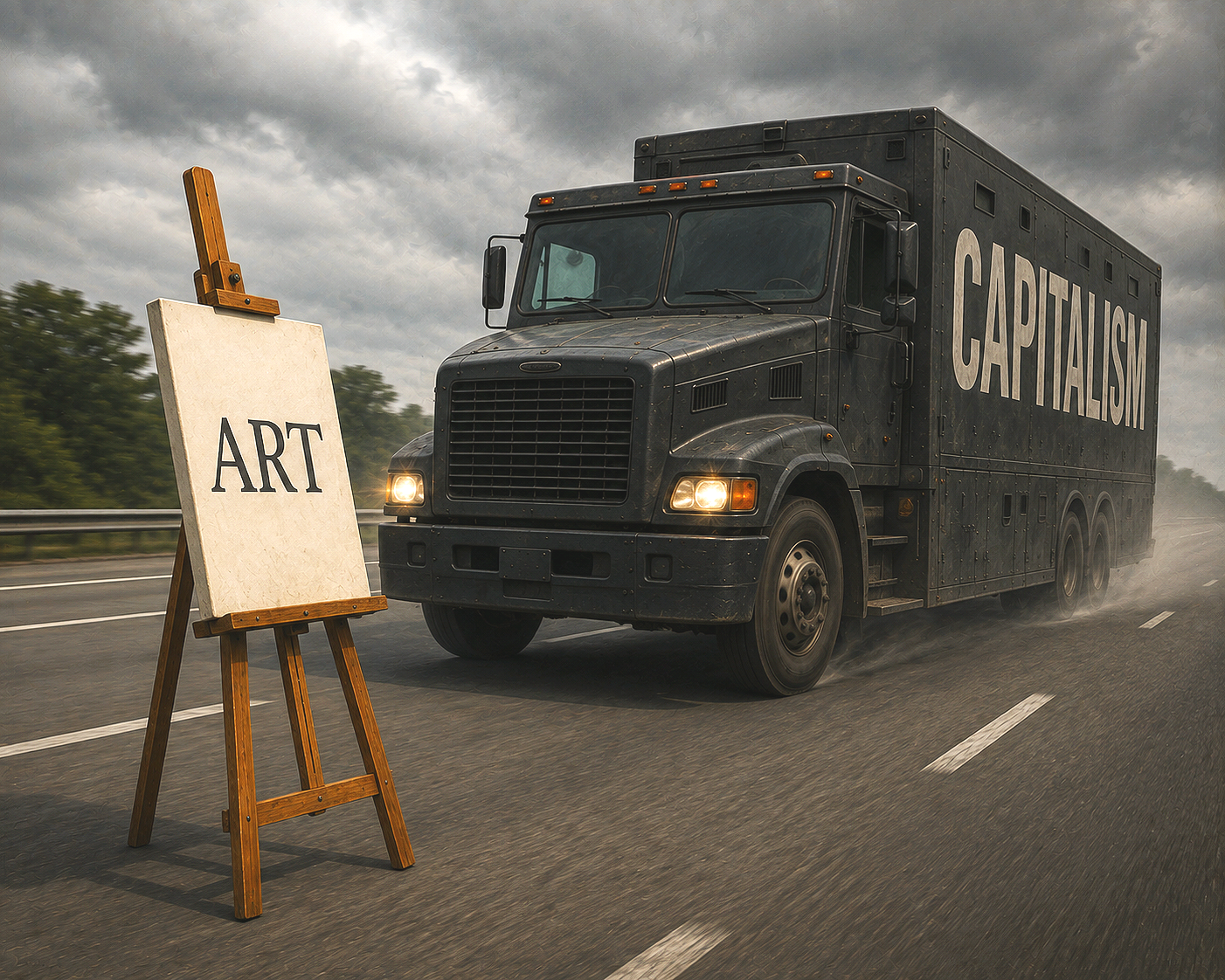
The easel doesn’t stand a chance unless the truck intentionally avoids running it over.
SpaceX launched a record-breaking IPO. NVidia and Sandisk have valuations over the moon, and speaking of high-flyers, Wall Street narratives about artificial intelligence companies suggest realms of limitless wealth, power, and potential.
But while the modern industrialists are gilding their new Xanadus, groceries cost a fortune, college educations are more expensive than ever, and rising health costs can make a strong person feel ill.
Who in their right mind could ever find value in a watercolor?
Value is a funny thing. What you might be willing to pay for in rubies I might not want even if it were free. In some regards, value is arbitrary. What’s the measurable value of a first kiss? It’s effectively free, and it’s simultaneously priceless. The same measure of value applies to Brahm’s String Quartet No. 1 or Twyla Tharp’s “Push Comes to Shove”. It’s even arguably true for Van Halen’s “Dance the Night Away”, presuming you’ve ever pulled up to an outdoor party in June. These works may have generated measurable returns on investment for their creators, but whether they’re valuable or not depends entirely on subjective assessments.
Free market folks will rush to assert that price is really just a function of supply versus demand, and they’re not wrong, of course. If your spiffy new rocket can’t reliably achieve orbit, market demand for its promises will be low, so it won’t be worth very much.
I think this is all missing the point. Price is not the same thing as value, and value is not always a proxy for cost. Capitalism insists on price. As capital moves around based on market desire, its potential energy or its imperturbability defines how much the market will pay.
Art behaves in ironic counterpoint. Nobody eats based on the sublime merits of a painting. Nobody stays warm with a clutch of poems. But as a social mechanism to inspire and propel and digest the challenges of life —and life is always about challenges, for everyone—art simultaneously has no ROI and infinite ROI. You can buy something like a sculpture, but you cannot buy the underlying motivations behind that sculpture’s creation.
Artists have always given away work for free. Making sales matters tremendously—artists have bills to pay just like everyone else—but selling work is hardly the only reason artists make stuff. As the title suggests, we’re no longer just dealing with ordinary capitalistic forces when we consider the value of art. Faced with competition from oceans of free creative work in the marketplace, it’s tough for artists to sell things. Conversely, the increasingly monopolistic influences from corporate gatekeepers narrows the lanes where creative work can find paying markets. To be sure, artists have a long history of financial challenge; there’s a reason we all know the phrase “starving artist”. But now things are harder. Musicians have few paths toward sustainability in the new economy. The economics of traditional theater have essentially transformed it into either a fun night out for the wealthy, a charitable enterprise that relegates its practitioners to subsistence living, or a creative pursuit by those who simply like doing it for nothing on community stages. Filmmakers facing a competitive glut of capable creators struggle too. Even for more established, better funded productions, schedules have shrunk, budgets too, and potential audiences have become more segmented, more fragmented, more isolated.
It’s tough to be an artist in America these days.
Economic traditionalists will tut-tut and declare that artists struggle because demand remain low relative to the costs of creating new work. Artists starve, on average, because most work does not rise to a level where people want to pay more. Spiderman captures a wide slice of the market for its easily accessible experience compared to, say, a new stage adaptation of Rhinoceros. Supply meets demand. The problem is that people who made Spiderman (Stan Lee as the 20th century originator, Destin Daniel Cretton as the director of the 2026 movie) are nurtured and fed by a lifetime of exposure to writers of things like Rhinoceros (Eugène Ionesco). An ecosystem cannot thrive with a monoculture. And this: don’t think for a moment that the wildly successful creators of mainstream tentpoles only watch popular entertainments. The reasons they can capture rich, popular vibes is precisely because they are conversant with deep roots of culture to inform them.
Capitalism is no longer an engine of modernity; it is the engine of modernity. With thinning ranks of winners taking disproportionally larger and larger slices of material wealth, the environment for most creatives has reached a crisis point. It’s true that there has never been greater democratic access to creative tools, but there has also never been so much downward pressure on making ends meet. It’s hard to compete with “free”, especially when selling things at justifiable cost effectively limits who can buy. Theater again: when tickets to a show cost hundreds of dollars a person, very few can afford to go. Even the best, most successful productions may not have staying power.
There are success stories, of course. Best selling authors can earn big bucks. A clutch of musicians rake the take at big shows. Surprising movies can unexpectedly capture the box office. But success stories up close often can cloud larger realities a few feet beyond. As the old saying goes, you can make a killing, but you can’t make a living.
Movies again: Hollywood may be having a banner year, but the aggregated profits of recent blockbusters deny a deeper, darker truth. Most day-to-day workers in movie production are barely holding on. The economics of late-stage capitalism threatens the critically important development years for many anonymous, yet essential creative workers who keep movie productions moving. Successful blockbusters make a thin sliver of people wealthy. The traditional movie mid-list almost doesn’t exist anymore. The low-end is awash with new creatives and projects who face absurd financial challenges and impediments. It’s true that some big winners emerge from the struggle, but the victories are often disproportionate to the work. We could chalk this all up to the law of supply and demand again, and that would be a legitimate argument. But in my estimation, that law used as a singular arbiter of artistic value can corrupt deeper, more important values. A healthy culture values its artists because artists serve an essential role of reflecting and refracting what’s happening in the world. A culture that starves artists stifles its own engines of inspiration, emotional expression, and vital dialogue about what it means to be alive.
This goes beyond art-as-entertainment. Movies and Broadway and big-ticket concerts do not describe most art. Most creative work takes place at exponentially smaller scales. But an accelerating trend toward pure capitalism, toward a singular pursuit of immediate return on investment, where apex winners scarf most of the rewards, threatens to upend our collective future. As capitalistic forces accelerate and widen the economic divide, we are all at risk of a cultural impoverishment that threatens us as a culture. Art imagines the intangible forces of our dreams and fears. Try to imagine a world where we cannot recall those dreams each morning because the alarm clock is only an alert for sending us all out to hustle for a buck. I prefer to live in a world where some of us stayed up late the night before to write an unforgettable song.